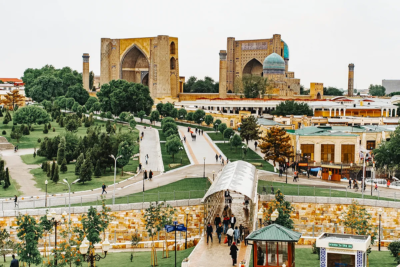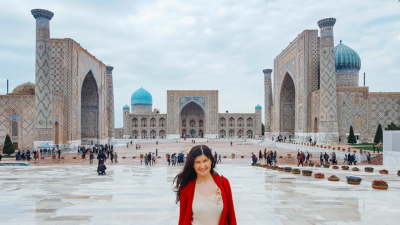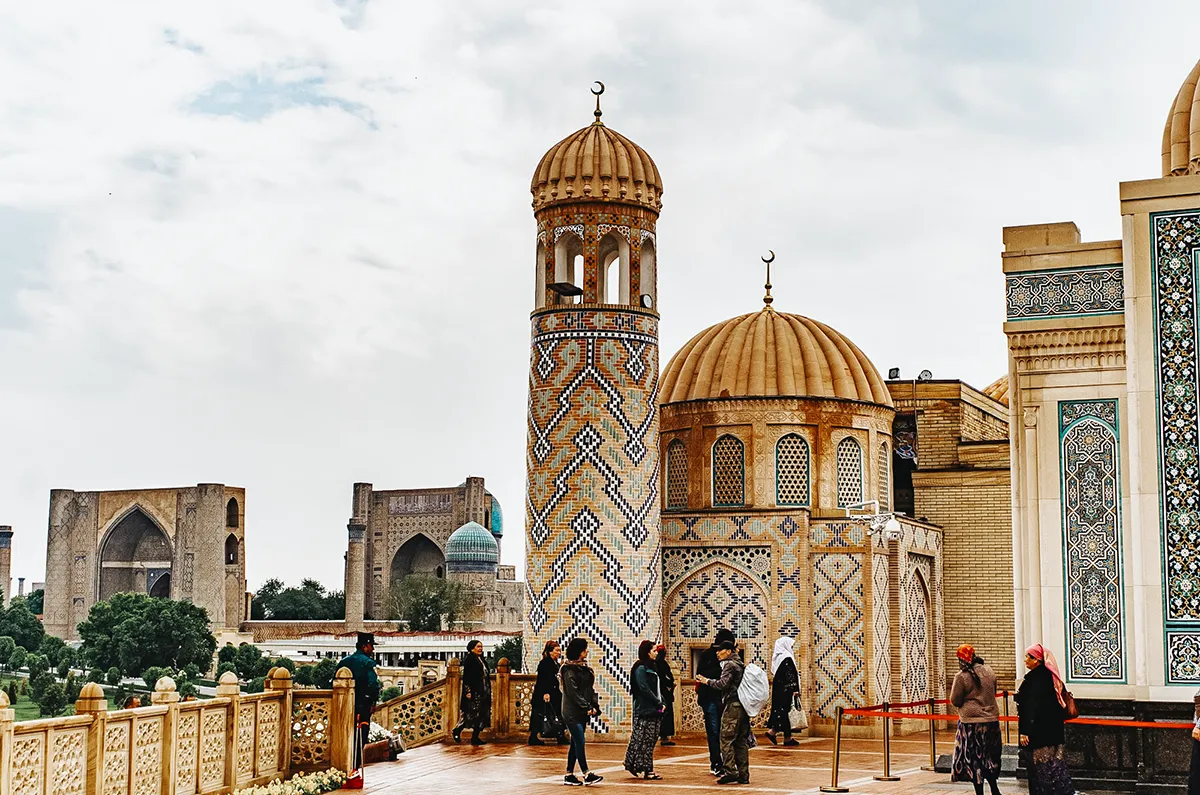
While one day is enough to see the main Timurid landmarks, spending two days in Samarkand allows you to visit important religious sites, archaeological areas, and lesser-known monuments that many travelers miss. Thus, this 2-day itinerary covers not only the city’s most famous monuments but also several fascinating sites located outside the historic center.
You can also use the second day to visit any sights you may have missed on the first day. For instance, we were very slow exploring everything on the first day, plus it was raining time after time, so we decided to move Shah-i-Zinda to the second day.
If you would like the practical information on transport, accommodation or restaurants in Samarkand, check out my Samarkand travel guide.
- Day 1: Samarkand Historical Center
- Day 2: Sites Beyond Samarkand’s Historical Center
- Imam al-Bukhari Mausoleum: Important Islamic Pilgrimage Site
- Ulug Beg Observatory: The Timurid Astronomical Wonder
- St Daniel’s Tomb: The Mysterious 18-Meter Grave
- Afrasiyab: The Ancient Settlement of Samarkand
- What to See If You Have More Days in Samarkand
Day 1: Samarkand Historical Center
On the first day, focus on Samarkand’s iconic historic sights located close to each other in the city center.
- Gur-e-Amir Complex with the mausoleum of Amir Timur
- Registan Square: Samarkand’s most famous landmark
- Bibi-Khanym Mosque and Mausoleum: one of the largest mosques of the medieval Islamic world
- Hazrat Khizr Mosque with beautiful views over the city
- Shah-i-Zinda Necropolis: a stunning complex of blue-tiled mausoleums
Day 2: Sites Beyond Samarkand’s Historical Center
With the main highlights covered, the second day can be dedicated to several interesting places outside the main tourist route, including the mausoleum of Imam al-Bukhari, Ulug Beg’s Observatory, the Afrasiyab archaeological site, and the tomb of Prophet Daniel.
Imam al-Bukhari Mausoleum: Important Islamic Pilgrimage Site
Entrance Price: 20,000 UZS
How to get to the Mausoleum: This mausoleum is located outside Samarkand, but it’s worth a visit. Keep in mind that prices for taxis to outside Samarkand are higher than inside the city and you can’t get a shared taxi to this mausoleum. Make sure to negotiate with the taxi driver to take you there, wait for you and bring back to the city. Alternatively, you can try ordering the car via the ride-hailing app, like MyTaxi or Yandex and negotiating with them to wait for you.
When at the complex, a couple approached us and asked us, what transport did we take to come here, and if it was possible for them to join us. Apparently, they took a shared taxi (which usually run inside the city) and thought that they would pay 5,000 UZS per person, as they were used to inside Samarkand. But I guess the communication failed, because to travel outside Samarkand the prices are far higher. So, the driver asked them for 50,000 UZS instead. They fought and left. We agreed to take them with us, but as there were additional people coming with us, the taxi driver asked them to pay whatever they could in addition to what we were paying. Not sure what they gave to him in the end.
Imam al-Bukhari was a prominent Islamic scholar, who was born in Bukhara in 810, hence, the al-Bukhari. He collected hundreds of hadith – that’s the verses and stories in Islam. He also taught disciples.
The small mausoleum over his grave was built in the 16th century. The current complex was built in 1998. It now includes not only mausoleum, but also a museum, madrasa and a mosque.
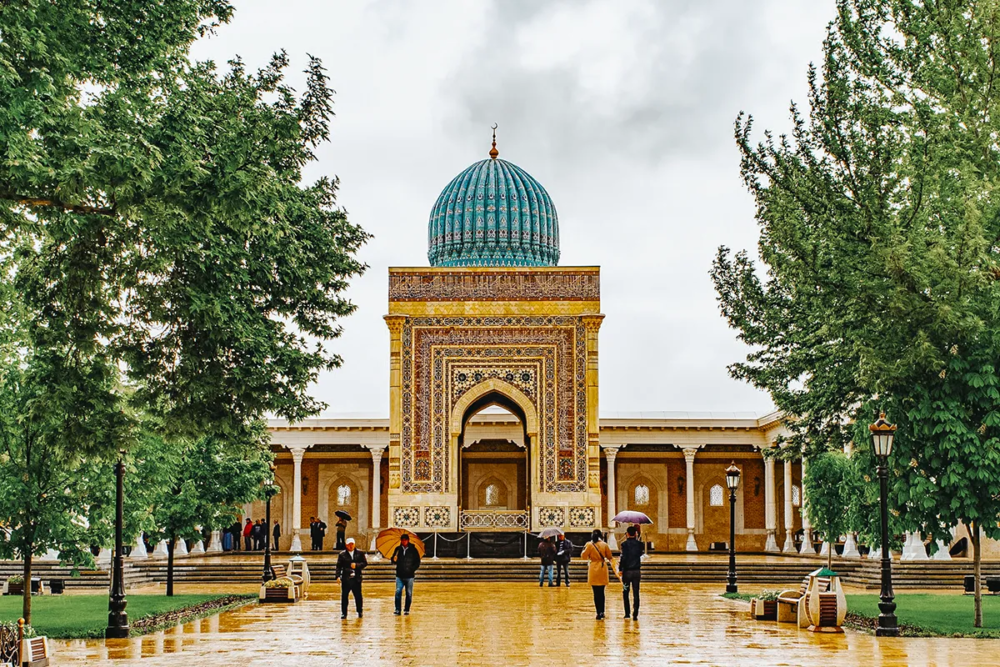
In addition, next to the old complex you will find a modern shiny building, which houses a museum. There is no one around, so we were very confused, as to the possibility of our visit. But the gates were open, so we just wandered around the grounds and asked a man working in the garden, if it was possible to visit the library inside. Apparently, it was not only allowed, but also free for anyone, who liked to visit. There was no one inside either and we were so happy to explore and learn about al-Bukhari, about the number of different Qurans in this library, paintings of Al-Bukhari and his disciples, etc. The people there were very nice and explained everything to us without even asking. Overall, we loved it and we suggest you check this place out. It’s not easy to miss, it’s a huge modern building next to the complex.
Ulug Beg Observatory: The Timurid Astronomical Wonder
Entrance price: 40,000 soms
Opening hours: 8am-7pm
After getting back from the Imam al-Bukhari Mausoleum, ask the taxi driver to drop you off at the Ulugbek Observatory and start walking to other sights from there.
At the street level, you will see a statue of Ulug Beg himself. Next to the statue, there are stairs leading up to the observatory. You are supposed to walk up from the stairs on the right side, the staircase on the left is for descending. We actually mixed it up.
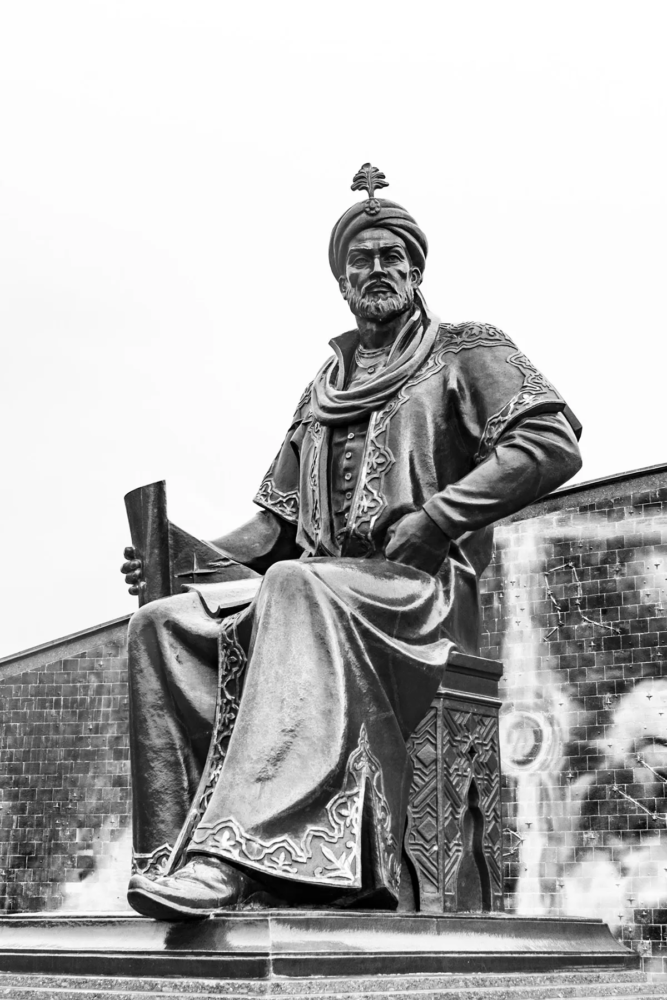
Ulug Beg, the most famous grandson of Timur and a scholar was particularly interested in astronomy. He built this observatory in 1420s. Looking at what is left now, you wouldn’t guess its former grandeur. It may be underwhelming, unless your imagination can depict it in its former glory.
Originally there was a round cylindrical building with three floors. Inside the building were three huge astronomical instruments. Part of only one remains now – the sextant, which was used to measure the angle of elevation of the celestial objects. Through this, the astronomers measured the length of the year, the exact time of noon, etc. The scholars believe that the measurements from those times were very close to current calculations, which is just unbelievable. The astronomers of the time had created a catalogue of over 1000 stars.
Next to the remains of the sextant is a small building constructed to house a museum with the information and exhibits telling a story of Ulug Beg and his many achievements in the field of astronomy. The museum is very small and can get extremely crowded, a couple of loud tour groups really didn’t make the experience very pleasant.
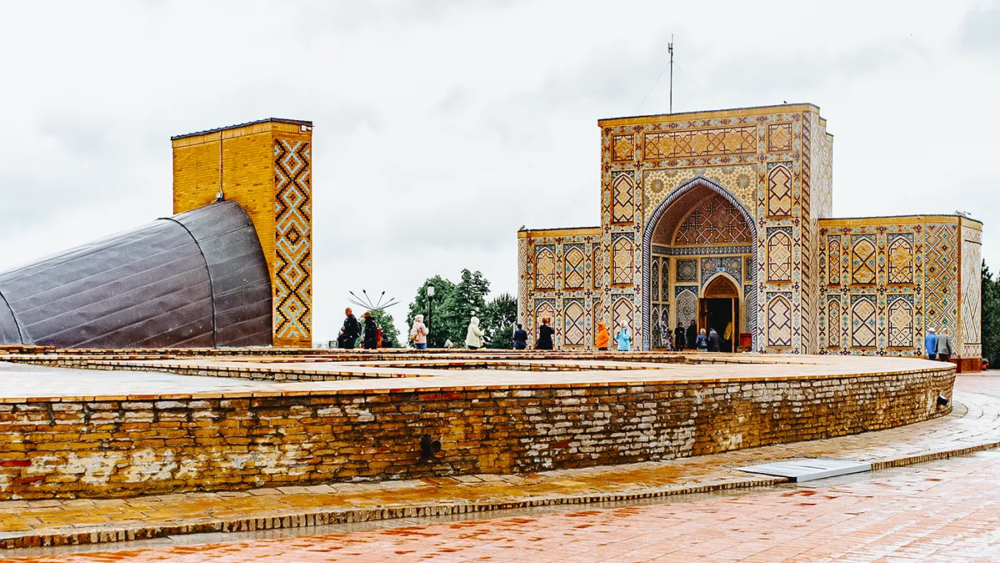
The scholar Beg proved to be an unskilful ruler. After losing a few battles, his son demoted him. He was officially sent to Mecca for pilgrimage but was assassinated on the way. After his demise, no one cared about the observatory any longer, so it was destroyed in 1449 and forgotten after that. All the scholars working here were driven away. Part of it was only rediscovered in the beginning of the 20th century.
St Daniel’s Tomb: The Mysterious 18-Meter Grave
Entrance price: 30,000 soms.
Opening hours: 8.30am-6pm
Walk from Ulug Beg Observatory: 15 minutes
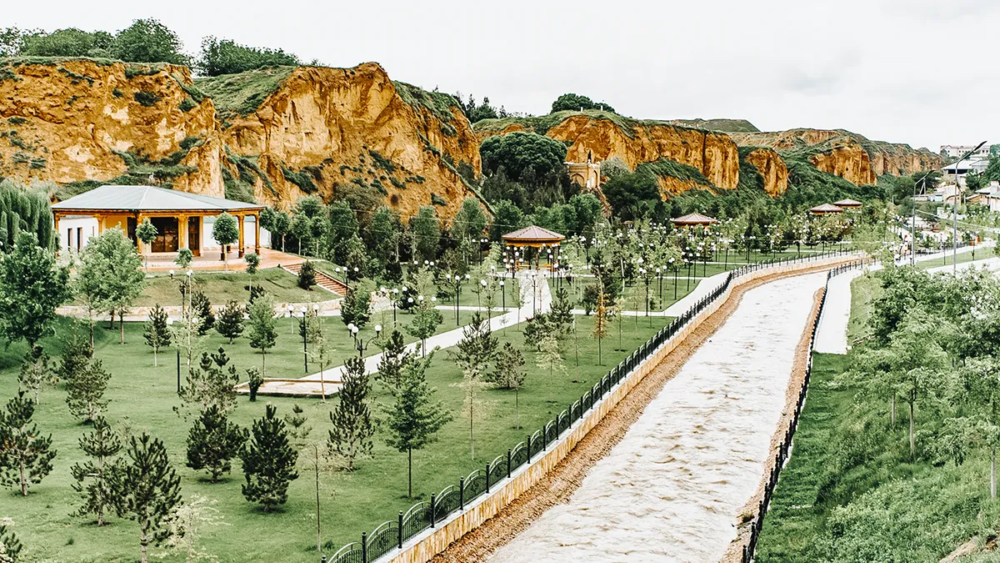
The mausoleum of prophet Daniel is located at the river Siab on the hill. Daniel was of the noble Jewish family, descendant of Kings David and Solomon. He was captured and lived in Babylon, where he became a famous scholar. According to the stories, Amir Timur brought his remains from Iran to Samarkand. Interestingly, not only this, but many other places in the world claim to have the grave of Daniel.
This is not one of those huge, magnificent buildings you will find in Samarkand. But it is still fascinating because of its beautiful setting near the river and because the tomb is 18 meters long. It’s even extremely difficult to take a photo of it. The tomb is covered with a green cloth with Arabic inscriptions.
There is a lot of mysticism and confusion associated with this place. People argue over the reason of the length of the tomb – some believe that it was made so long to avoid detection of a real grave and hence the robbery, others think that it magically grows every year. Besides this, no one really knows what is inside the tomb, whether Daniel’s hand, just earth brought from his grave or anything else.
Afrasiyab: The Ancient Settlement of Samarkand
Entrance price: 50,000 soms.
Opening hours: 8.30am-6pm
Walk from St. Daniel’s: 10-15 minutes
Originally, the ancient city located on the territory of modern Samarkand was called Afrasiyab. Not much is left from this fascinating civilization now, but it is still interesting to think that there was the whole city here some 27 centuries ago.
The scholars believe that Afrasyiab settlement existed from about 7th-6th century BC until it was completely destroyed by the Mongols in 1220. People were so scared after this destruction, that they never settled in this place again and moved down the hill.
As a result, the area was never settled again and you will still see the bare hilly territory, where Afrasyiab was located north of Khazrat Hizr. The settlement was long forgotten until excavations started by the Russian archeologists in the 19th century. Their findings are now located in the Afrasyiab museum.
To visit the museum and the area, you can either walk there from St Daniel’s Mausoleum and then walk to Hazrat Khizr or vice versa (it’s 10-15 minutes’ walk in either direction). While walking, you may feel like you are in the middle of nowhere, but don’t be deterred by that, it is not a very long walk. In this museum you will find the panels with painting depicting the scenes of battles, coronations, etc. You will also find a number of clay pots and other utensils, the heating ovens, the bathhouse materials and many other interesting things.
This museum is not often visited by tourists. We only saw a couple dozen people overall around the area. While it may not be as fancy as other sites you will see in Samarkand, I believe it’s still important for its historical significance. So visit, if you have time.
What to See If You Have More Days in Samarkand
If you have extra time in Samarkand, there are several interesting places you can visit beyond the city itself.
One of the most popular day trips from Samarkand is Shahrisabz, the birthplace of Amir Timur, located about two hours south of Samarkand. The city is known for the ruins of Timur’s Ak-Saray Palace and several other historic monuments. I recommend hiring a private driver to take you to Shahrisabz, as this would be too difficult by public transport.
Another option is to spend more time exploring less-visited parts of Samarkand, including smaller mosques, traditional neighborhoods, and parks around the city:
- Jewish quarter and Gumbaz synagogue.
- University Boulevard with Soviet buildings.
- The Central Park.
- Khodzha Abdu-Darun Mausoleum and Ishtarkhona Mausoleum.
One more option is a day trip to Panjakent and Seven Lakes in Tajikistan. There are guided tours with transportation included, which makes such day trip possible. Visiting Seven Lakes is impossible by public transport anyways, and going to Panjakent by shared taxis takes quite a lot of time – it took us a few hours to just get to Panjakent from Samarkand. Therefore, the guided tour is your only option, if you would like to take a day trip.
Join our travel community on Facebook Coffee Fueled Travel Club
See Also