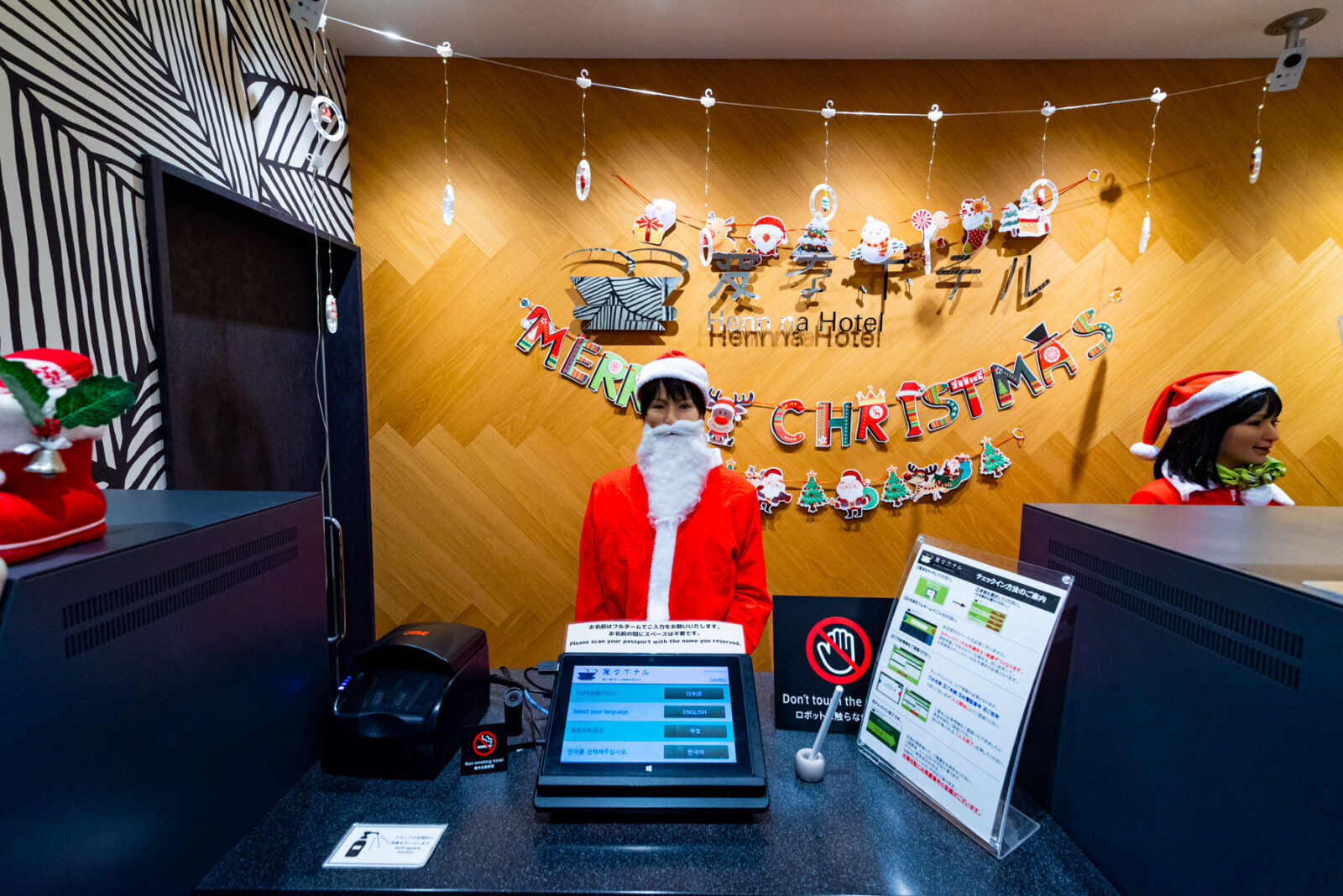
If you are planning your first trip to Japan, chances are you haven’t heard of Japanese business hotels. While Japan offers everything from luxury hotels and ryokans to capsule hotels and hostels, Japanese business hotels are one of the most practical and reliable budget accommodation options across the country.
You’ll find them in almost every city, usually near train stations, offering clean, compact rooms with everything you need for a comfortable stay. They are often referred to as budget hotels in Japan, but they are much more comfortable than that sounds.
- Who Should Stay at Japanese Business Hotels
- Main Features of Japanese Business Hotels
- Strategic Location
- Small Rooms
- Price Range
- Check-in and Check-out Times
- Check-in and Check-out Machines
- High Tech Toilets
- Room and Bathroom Amenities
- Lobby Amenities
- Cleaning
- Breakfast Options
- Luggage
- Smoking and Non-smoking Rooms
- Drinking Water
- How to Book Japanese Business Hotels?
- Booking Directly with Hotels
- Booking through Third Parties
- Tips for Booking Japanese Business Hotels
- The Best-Known Japanese Business Hotel Chains
- Sotetsu Fresa Inn
- Our Stays at Sotetsu Fresa hotels
- Toyoko Inn
- Our Stay at Toyoko Inn
- Henn na Hotel
- Our Stay at the Henn na Hotel
- Unizo Inn
- Our Stay at the Unizo Inn
- Wing International
- Our Stay at Wing international
- APA Hotels
- Our stay at the APA hotel
- Hotel Keihan
- Our Stay at Hotel Keihan
- Daiwa Roynet
- Dormy Inn
- Other Business Hotel Chains
Who Should Stay at Japanese Business Hotels
If you are looking for budget to mid-range accommodation but don’t want to stay in shared spaces, Japanese business hotels are a great option. Compared to capsule hotels or hostels, they offer full privacy, while still being more affordable than traditional hotels or ryokans. They are also much more practical if you have luggage.
These hotels are ideal for no-frills travelers who don’t need anything fancy, just a clean and convenient place to stay.
As a budget-conscious traveler who isn’t keen on hostels, I always choose Japanese business hotels. In Japan, we stayed in over 10 different ones across 7 chains and liked all of them. We also stayed in them in South Korea and the Philippines – we loved Toyoko Inn Seoul Dongdaemun, Toyoko Inn Busan Seomyeon and Toyoko Inn Cebu.
On the other hand, if you are looking for spacious rooms, luxury amenities or a more traditional hotel service experience, this is probably not the right option.
Japanese Business Hotels Are Best If You:
- Want budget to mid-range accommodation
- Prefer privacy over hostels
- Stay mostly in cities
- Don’t need much space
Main Features of Japanese Business Hotels
As the name suggests, Japanese business hotels follow a pretty standard concept – compact rooms with all the essentials, nothing over the top, nothing unnecessary. They were originally designed for business travelers, but these days you will see plenty of tourists staying in them too.
There are some specific differences between chains, but overall the experience is very similar. Once you stay in one, you will more or less know what to expect from the rest. Here’s what you can expect when staying in Japanese business hotels.
Strategic Location
The Japanese business hotels are usually located quite close to major transport options. There are certainly exceptions, but more often than not you will find either train or bus station nearby.
This is especially useful in cities like Tokyo, Osaka and Kyoto, where staying near a station saves a lot of time.
For tips on transport options in Japan, see my comprehensive guide.
Small Rooms
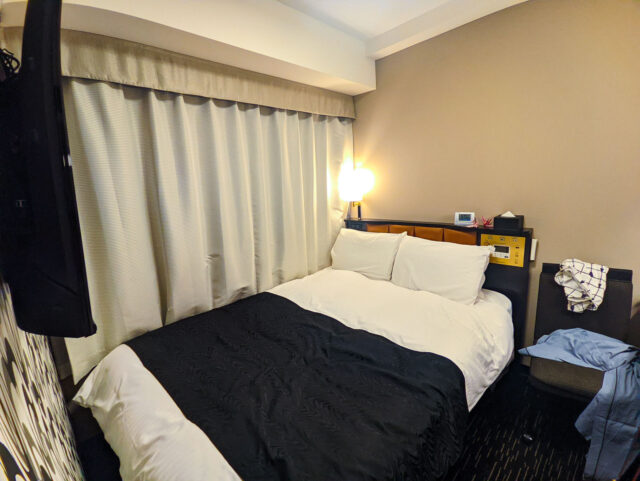
The rooms are usually quite small, so are the bathrooms. This is one of the most common features, all Japanese business hotels share. One thing we noticed is that twin rooms are often slightly bigger than double rooms. I am not sure if this observation is generally reliable, I would love to hear about your experiences.
If you are particular about having enough space for your luggage and clothes, then these hotel rooms may be small for you. They work especially well for solo travelers or couples, but can feel tight if you have multiple large suitcases.
We traveled as a couple and managed to find some space for our two suitcases in all of the double or twin rooms. Quite often it was difficult to pass next to the luggage though.
Price Range
Prices usually stay in the budget to mid-range category, depending on city and season, but they are almost always cheaper than standard hotels in Japan.
Check-in and Check-out Times
The business hotels are strict about their check-in times. We didn’t have any case, when they offered to check us in slightly earlier, but we didn’t ask really.
Check-in and Check-out Machines
Many of the business hotels have self-service check-in and check-out machines. This means that you will have to scan your passport, the machine will find your reservation and print out the room number, as well as room keycards. Similarly, you can easily check-out by inserting your keycards in the machine. However, if you don’t manage yourself, there’s always staff to help you out with this.
High Tech Toilets
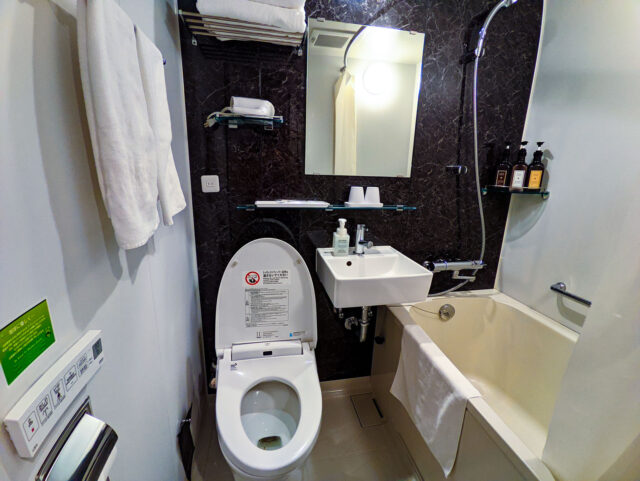
Toilets are on a whole different level, as everywhere in Japan. All business hotels come with high-tech toilets that warm up the seat, work as a bidet, self-flush, and sometimes even play music to cover up the sounds. Like many other travelers, we really wish we had one at home too. We seriously considered this after our first trip.
Room and Bathroom Amenities
All business hotels we stayed at were clean and had everything we needed for a comfortable stay. I’m usually quite picky with hotel towels, but I had no issues using them in any of the business hotels.
Here’s what you can typically expect in Japanese business hotel rooms and bathrooms:
- Shampoo, shower gel and conditioner, as well as handwash.
- Electric kettle and fridge are available. You can always bring the ramen from konbinis to snack on.
- Hair dryer.
- TV and good wifi connection.
- Iron may be available in your room. If not, you can request it.
Lobby Amenities
You will usually find additional amenities in the lobby:
- The stands have toothbrushes, razors, cotton pads, skincare (moisturizer, cleanser, sometimes even sheet masks), tea, coffee, etc. Sometimes you will even find hair ties or other things you would not even think of.
- Interestingly, all of the hotels provide pajamas. I haven’t seen this in other hotels worldwide. You may see pajamas in the room or in the lobby. If not, just ask, they always have them. In some hotels, like APA, they even provide traditional Japanese robes, called Yukata. You will also find slippers in the rooms (I remember seeing them in some, but I didn’t pay attention, if they were in all, as we always carry our own slippers).
- You can borrow umbrellas on rainy days. So don’t bother packing an umbrella, just ask at the reception. The umbrellas are always the the transparent ones you see everywhere in Japan. They are very sturdy and survived strong rain and wind in Kanazawa.
- All of these hotels have communal laundry machines. I am not sure how much you usually have to pay for them, because we didn’t use them, but having an option is great.
- You will also find a microwave in the lobby of the hotels for you to use.
- Many of the hotels will also have the water dispenser in the lobby, however, tap water in Japan is drinkable, so we were often drinking from our bathroom tap.
- The hotels often have vending machines in their lobbies. But usually you will find a convenience store just a few steps away.

Cleaning
Most Japanese business hotels have a rule that they clean the room every 3 or 4 days, or whenever you ask. They have the signs for you to put out, when you need to have the room cleaned, if you just need to get towels, or if you don’t need anything.
Breakfast Options
Most of the business hotels offer breakfast options. Some, like Toyoko Inn chain offer it to everyone – it’s always included, while for others you will need to book it with the room or separately.
Luggage
All business hotels will keep your luggage before check-in time and after check-out for the day. If you inquire, some of them may even keep it for a few days, if you are going back to the same hotel – we were able to do this twice.
All hotels offer the luggage forwarding service, as do the convenience stores. People say this is cheap and easy, but paying 2000+ JPY for one suitcase per one move didn’t sound cheap to us at all. Plus, you need to keep in mind that most of the time they can’t deliver your luggage next day, so you will need to wait. If you give the hotel your luggage in the morning, it may be delivered next day (but not necessarily). Same day delivery is impossible. So you will have to choose, if it’s worth for you at all. Many people love this, as they travel without much luggage. We didn’t use it at all though, as it would simply cost us too much and it was difficult to figure out the clothes and everything else on the days we wouldn’t have our luggage.
Smoking and Non-smoking Rooms
Some of the hotels offer smoking and non-smoking rooms, while others are exclusively non-smoking. If you are sensitive to smells, make sure to book a non-smoking room. I have seen even some smokers complain about the smell in the smoking rooms.
Drinking Water
Many hotels provide drinking water tanks at the lobbies, so you can fill your bottles there. However, even if this isn’t available, water in Japan is safe to drink, so we did drink tap water from our hotel bathroom on a number of occasions with no issues.
How to Book Japanese Business Hotels?
Booking Directly with Hotels
Most Japanese business hotels have points system. If you register with them and have the membership, you get some discounts and accumulate points. This may be very useful, if you stay in the same chain several times. So make sure to look at those options before booking. Examples include Toyoko Inn membership card, which costs 1500 yen and gives certain discounts, APA Member’s Club, Loyalty scheme of Sunroute, etc.
Booking through Third Parties
In my experience third parties always offered cheaper rates than direct booking. I am not sure what the reasons behind this discrepancy are, but I found the Booking.com, Hotels.com, Expedia and Agoda provided certain deals, which were not offered on the hotel websites.
I booked all our stays at Japanese business hotels via third parties every time. I was monitoring the prices and changes easier through these websites. I actually found Booking.com deals to be best early on and Agoda deals better as time went by. So monitor these websites and see what works for you.
Tips for Booking Japanese Business Hotels
Whichever booking platform you choose, don’t leave booking the hotels till the last minute, if you are visiting during a busy season. However, keep in mind that not all hotels release the room availability at the same time. Some may do so six months in advance, others only three months before your stay. So make sure to look early on, as well as somewhat closer to your dates.
Check out my post for the checklist of everything you need to book in advance, before your trip to Japan.
One important suggestion is also to be mindful of the dates and days of the week you are staying at the hotels. Some cities, like Kyoto can be extremely expensive on the weekend, while not so much on weekdays. In Tokyo or Osaka this distinction is less prominent. Besides, it also matters, if you are travelling on holidays – the rates increase. So make sure to double check, how much the rates increase if you include the weekend and modify your dates accordingly if you need to save money. For instance, I booked our Kyoto stay Sunday to Friday, skipping the weekend days, which made the stay cheaper. The weekends we spent in Osaka and Tokyo, where staying on the weekend didn’t increase the price that much.
I cover more Japan travel planning tips in my Japan travel guide.
The Best-Known Japanese Business Hotel Chains
There are quite a few Japanese business hotel chains, and while they all follow a similar concept, there are some small differences in room size, amenities and overall feel.
Here are the main Japanese business hotel chains we stayed at, plus a few others you will come across when planning your trip.
Sotetsu Fresa Inn
One of the most popular chains, which many tourists often suggest, as a good budget option. They have over 40 branches around Japan and even one in Seoul. However, this hotel chain has been around for a long time, so some of their branches are quite old. If that matters to you, double check before booking.
The Sotetsu hotels have very small rooms. These rooms were one of the smallest compared to the other chains we stayed at. They had comfy enough beds and all the amenities I listed above. The bathrooms were older, but clean. The main thing was that the bathroom was also the smallest, compared to other hotel chains. Hubby hardly fit into them.
Our Stays at Sotetsu Fresa hotels
- Sotetsu Fresa Inn Tokyo Tamachi branch: The hotel was very well connected, although not too close to any of the sightseeing areas. It provides a direct line to Haneda, as well as Narita and is close to the Yamanote line Tamachi station. The hotel has several convenience stores very close, with Lawson just next door. We used the machine to check-in and check-out and it was very easy and quick. They provide breakfast at the attached Chinese restaurant. It was basic, but quite filling with the rice, fish, buns, vegetables, etc. They also had quite good coffee.
- Sotetsu Fresa Osaka Kitahama: This branch was also well connected with two metro lines nearby. It had the Lawson and 7/11 just next door. Not sure if they provide breakfast, we didn’t try it. The rooms were very small – as is the case for most branches of the chain – but provided everything needed.
- Sotetsu Grand Fresa Kumamoto: This one was in the heart of the downtown. The rooms here were slightly bigger, compared to other branches. Plus, bathroom was exactly the same, as everywhere else.
Toyoko Inn
This chain is very basic and I believe one of the cheapest. It also seems to be the largest with over 200 branches around the country. We first stayed at this hotel chain in Seoul and Busan. We actually were happy with both, as they were well-connected to public transportation, clean and convenient.
The main characteristic of this chain is that it always provides free breakfast to all its guests. The breakfast is pretty basic, with soup, rice, some vegetables, fish. They also have coffee.
Another difference is their check-in and check-out times. They have earlier check-out of 10 am than most other hotels, and later check-in of 4 pm. They are very strict about this and never allow early check-in whether they have free rooms or not.
Our Stay at Toyoko Inn
We stayed at Toyoko Inn near Kyoto Shijo-Omiya station. I actually booked it 5 months in advance and it was sold out quite soon. It was very reasonably priced for Kyoto. The hotel provides direct train link to Osaka with Hankyu line trains, which are slower, but also cheaper than Shinkansen. There’s also a direct link to Arashiyama from here. The location has many bus stations nearby, which will get you to the Kyoto station. There are also many convenience stores around.
We booked a twin room and it was bigger than double rooms of this chain. It was also somewhat older, but clean and we were pretty happy with it overall. My only issue with this Kyoto branch was that the beds were very hard, which wasn’t the case in some other locations of Toyoko Inn. Therefore, I can’t say what the standard is.
Henn na Hotel
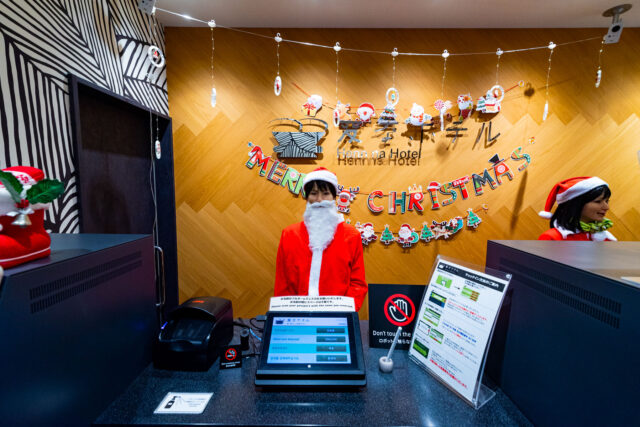
The name is translated as “strange hotel”. They are the first hotel, which introduced robot receptionists in the lobby and self-check-in. The chain is actually growing and they apparently even opened branches in Seoul and New York.
Our Stay at the Henn na Hotel
We stayed at Henn na Hotel in Tokyo Akasaka. This branch has 3 different metro lines nearby and is very easily accessible. There are also Family Mart, 7/11 and many other shops and restaurants nearby. We were welcomed by the android receptionists. Tried the self-check-in machine, which didn’t scan our passports, so had to call staff, who came out from the back room. The staff sorted out check-in and it didn’t take much time.
The hotel offered all amenities I described above. The main difference was the robot staff. By the way in Kanazawa branch they have dinosaur robots. Besides, they offer some technological innovations. For instance, in our room, there was an LG styler – it’s a sort of closet, which steam cleans the clothes you put in it. Before this, I had no idea this even existed.
Another difference of the hotel was also the luggage storage. We didn’t give it to staff, we simply hooked to the baggage slots in the relevant area.
The room was standard business hotel size, slightly bigger than Sotetsu Fresa rooms we stayed at. The bathroom was modern and clean. The beds were comfy. Overall, we liked everything here, except the fact that they entered the room and cleaned the bathroom, while we had a “do not disturb” sign on. That was pretty odd, but well, nothing bad happened. We didn’t try their breakfast, which they offered it in the attached Irish pub.
Unizo Inn
This chain is much smaller and less known than some of the bigger names on this list. They have only a few branches in Kanazawa, Osaka and Kobe. This business hotel was actually my favorite among all the chains we tried.
Our Stay at the Unizo Inn
We stayed at their branch in Kanazawa, which was conveniently located one bus stop away from the Kanazawa station and near the Kanazawa castle. The lobby was nice with a tiny Japanese garden design.
The hotel had all amenities I listed above. Our room was the biggest among all business hotel rooms we stayed at and the bathroom was modern. By the way, we had to use their umbrellas for two days in very heavy rain and wind (we were very unlucky with the weather during our stay in Kanazawa), but they survived very well.
Wing International
Even though you may not hear about this business hotel chain as often, as others, this is not a small chain. It has 38 branches around Japan and expanding. It actually is a very neat modern chain.
Our Stay at Wing international
I chose Wing International in Takayama, where options were relatively more limited than in bigger cities. The price was great, and it was close to the train station – about 7 minutes’ walk. The hotel actually turned out to be modern and overall very nice. It of course with all amenities you usually find in business hotels. They offered breakfast as well, but we booked without, so didn’t try it out.
APA Hotels
This is one of the most popular and biggest hotel chains with over 150 branches around Japan. APA hotels are usually very conveniently located in central areas or near the transport hubs.
Our stay at the APA hotel
We stayed at the APA hotel Fukuoka Hakata branch and their rooms were definitely small. The main difference was that the amenities (like toothbrushes, one use razors, cotton swabs and what not) were actually in the room, so you couldn’t freely choose from the lobby what you needed and what you didn’t. I personally preferred when I could choose, as there are some things I use more, while others that I don’t need at all.
One interesting difference in the APA hotel was that they have Yukata (traditional robes) in the rooms, instead of normal pajamas.
The luggage storage before check-in and after check-out is available – they will have you go on a website, where you generate some code and leave your luggage at the lobby.
Hotel Keihan
With over 20 branches around Japan, this hotel chain is less known than the giants listed above, however it provides everything you need.
Our Stay at Hotel Keihan
As I found a decent offer while staying in Osaka, I chose the Hotel Keihan Yodoyabashi. What I particularly appreciated about this hotel, was that they kept our suitcase for several days in between our two stays, which made our trip so much easier. While I had done this in so many countries in the world, some Japanese business hotels, like Toyoko and APA, don’t provide this option. I haven’t asked at every chain though.
The hotel provided all needed amenities, as usual. I don’t have any different comments about the room or bathroom, they were small and clean, as one expects from every business hotel. The location of this branch was also good, close to Midosuji metro line.
Daiwa Roynet
Daiwa Roynet is another very popular chain. It seems to be more expensive than most. I actually plan to check it out next time, if I find a good deal. On our previous trips, the price difference with other hotels didn’t seem worth it for us to try it.
Dormy Inn
Dormy Inn chain is particularly known for having on-site onsens (sort of hot springs or spas). They also offer free ramen in the evening. I am planning to check this chain out during our next trip.
Other Business Hotel Chains
Smile Hotel: This is one of the cheaper hotel chains.
Route Inn: The specific feature of this chain is that its branches are located near highway exits. It may be useful for you, if you rent a car and drive.
Sunroute: This is another chain apart from Toyoko, which seems to provide free breakfast for all.
Tokyu Stay: The distinctive feature of this chain seems to be that they provide microwaves and sometimes other kitchen items in the rooms. They also advertise that they have washer-dryers in every room.
Japanese business hotels are a great accommodation option in Japan. I wish they were more common in other countries as well. I will definitely continue choosing them over other options, wherever they are available, given that they provide everything budget conscious travelers need.
Join our travel community on Facebook Coffee Fueled Travel Club
See Also